Questions & Answers
Over the years, people have asked about Jääportit: where the music comes from, how it is made, and what it means. Here are some of those questions, with my answers. If you have one of your own, send it to jaaportit@gmail.com.
The project
Q: Who is T. M. Mäkelä?
A: I am T. M. Mäkelä, a composer and sound designer from Oulu, Northern Finland, and Jääportit is my work. I started it in 1997 with no particular plan, only a need to put something into sound. I have no formal music education; everything came through years of listening, experimenting and working in solitude. The northern landscape, the long winters, and the silence of the Finnish wilderness have shaped the music and the thinking behind it. By day I work in sound design, music production and graphic design. Jääportit has been my project from the start, with other musicians joining along the way.
Q: What is the meaning of your moniker Jääportit?
A: Jääportit means The Gates of Ice or more freely translated The Frostportals. This name came to me one night in 1997.
– Ice and frost represent the coldness within and the coldness without oneself.
– The Gates are about something pompous, a place where you could enter, a place where you haven’t been before. Also read the question about the logo & symbol at the bottom of the page.
Q: I assumed you are Jääportit; is there anyone else involved?
A: It is my project, but a few others have been part of it over the years:
- TikSu Sainio lends her voice to Muinaisvoimaa and extends the world of Jääportit into image through music video direction and photography.
- Vesa Partti plays electric guitar on the song Gnosis released on compilation album “My Own Wolf: A New Approach to Ulver” (2007).
- J-M Kenttälä plays acoustic guitar on the song Sydänyön samooja syvällä unten mailla ja metsien soilla released on compilation album Sonic Visions of Middle-Earth (2005).
- Mindy played the acoustic violin, did vocals in a few songs and created album cover artwork paintings for Jääportit albums. She is no longer involved in the project.
Q: Would you be interested to perform live at our party?
A: Jääportit has performed live on rare occasions and may do so again in the future. See the Events page for any upcoming shows, or get in touch via email if you are interested in a booking.
Q: What kind of gear do you use in your studio?
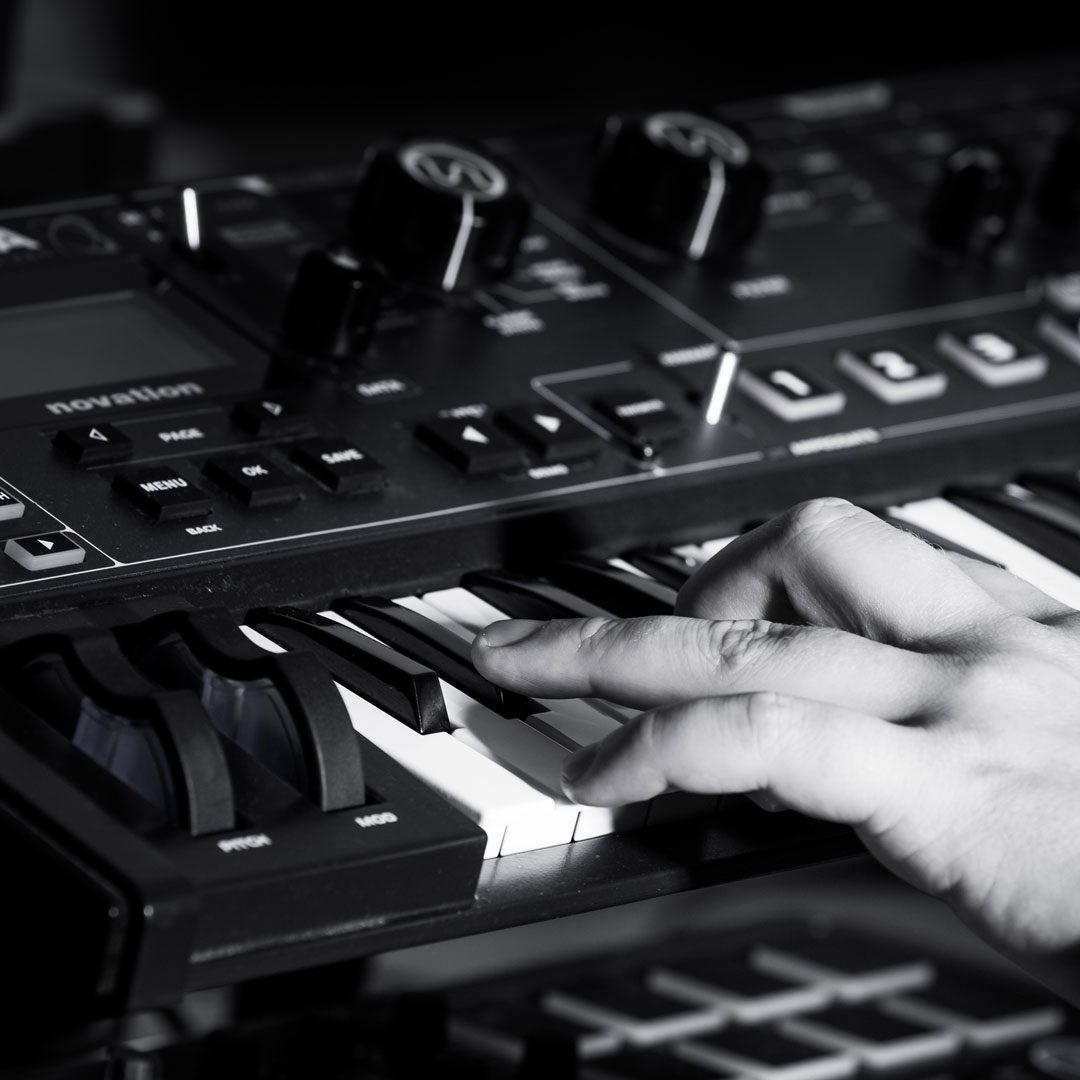
A: The core of the Jääportit sound is built around electric guitar, bass, and synthesizers, recorded and sculpted in a modern digital audio workstation. Electric guitar and bass have become central to many compositions in recent years, with their textures and tones shaping much of the atmosphere alongside the synthesizer work. All drum and percussion parts are programmed. Melodica, flute, and other acoustic instruments appear occasionally in the arrangements.
The music
Q: How would you describe the music of Jääportit?
A: Cold, melancholic, melodic. There are synthesizers, electric guitars, bass, ambient textures, and field recordings. Sometimes sparse and minimal, sometimes layered into something more dense and cinematic. The music is shaped by winter and the emotional landscapes that come with it: darkness, silence, the particular feeling of northern Finnish nights. I would not call it pure ambient. The melodies matter too much. The most important elements have always been melody, a certain simplicity, personality, and soundscape. Comparisons to Vangelis, Jean-Michel Jarre, or Tangerine Dream are not entirely wrong, but the intention here is something darker and colder than any of those.
Q: Are there any lyrics, and what language are they in?
A: Most of the music is instrumental. Some pieces include spoken words or sung vocal fragments, always in Finnish. Album titles, song titles, and any text used in the music are in Finnish because it is the language I think and feel in most naturally. It also makes the music sound more Finnish and strange in a way that feels right. There is something in the sound of the language itself, something you do not hear in more widely spoken tongues. Finnish is understood by around five million people, and that particular smallness and strangeness is part of the character of Jääportit.
Q: How do you approach composing? Where does a new piece start?
A: Almost always with a melody fragment, something that appears at the keys and feels worth following. If it holds something real, I continue. From there it becomes a process of building atmosphere around that core: finding the right sounds, layering bass and texture, sometimes field recordings captured outdoors. Jääportit music only comes during winter, from late autumn through to spring. Other seasons rarely bring it. Inspiration arrives from the emotional weight of daily life: memories, nature, films, literature, visual art, and the specific silence of northern Finnish winter nights. Sometimes it feels like the music already exists somewhere, and I am only the one finding it and bringing it out.
Q: What musicians or albums have influenced Jääportit the most?
A: Early on, the music of Mortiis was a discovery. Atmosphere and texture alone, no conventional instrumentation. Hearing it made that approach feel like something real. Around the time of Kauan koskematon, artists like Arcana, Raison d’être, Die Verbannten Kinder Eva’s, Dead Can Dance, Anathema, and Katatonia were important. Later I moved further toward Biosphere, Steve Roach, Robert Rich, Chopin, Hawkwind, Pink Floyd, and Ulver. These days I listen across many different styles. Whatever catches the ear leaves something behind.
Q: Let me ask you something, was there any one thing in particular that inspired the creation on song “Maa pirstaleista”? I think I remember reading somewhere that you were inspired by glaciers and other things of the sort (not for this song in particular, but overall).
A: For the creation of the track Maa pirstaleista I got inspiration from the melancholic feelings when it seems like the earth under your feet starts to break down and there’s nothing you can do about it. Only the fragments remain. Glaciers reflect more the meanings behind the name of the band and the overall feeling behind all of the tracks.
Q: What about for the track “Pois muodot huuhtoo”?
A: Track Pois muodot huuhtoo (Leaching Shapes Away) deals with the water elemental. Natural ambience was created from the field recordings at Ainola Park in Oulu, Finland.
Releases
Q: What’s the best place to purchase your albums?
A: There are a few personal copies of some albums left. Check the Jääportit Web Shop for what is available.
To download the full digital discography in high quality, visit Jääportit Bandcamp.
Q: Where can I stream the music?
A: The music is available on the major streaming platforms: Spotify, Apple Music, and YouTube, among others. The complete discography in high quality, with lossless options and name-your-price downloads on select releases, is at jaaportit.bandcamp.com. Bandcamp is the preferred option if audio quality matters to you.
Q: I would like to buy ‘Kauan koskematon’ album, where can I get it and was it really published as a cassette?
A: Yes, Kauan koskematon was published as a 500-copy limited edition cassette tape. The record label’s original plan was to release it on CD or CDR, but due to financial constraints it ended up on cassette in autumn 1999. All copies sold out within about a year and it is not available in that format anymore, though it occasionally surfaces in second-hand stores. The album was re-released on CD in August 2018.
Q: Is it possible to get a copy of ‘Halki lumisen metsän’ CDR from you please, as I really want to hear it?!
A: All copies of the original demo CDR sold out long ago, but you can now get it as Kauan Koskematon / Halki Lumisen Metsän CD released in August 2018.
Q: Can you give me more details on that Lovecraft compilation?
A: It includes one special and extended Jääportit track titled Kuihtuman henkivi. A Lovecraft-themed compilation album titled YOGSOTHERY – Gate I: Chaosmogonic Rituals Of Fear was released by I, Voidhanger Records, November 15th, 2010.
Visuals
Q: What does your logo represent?
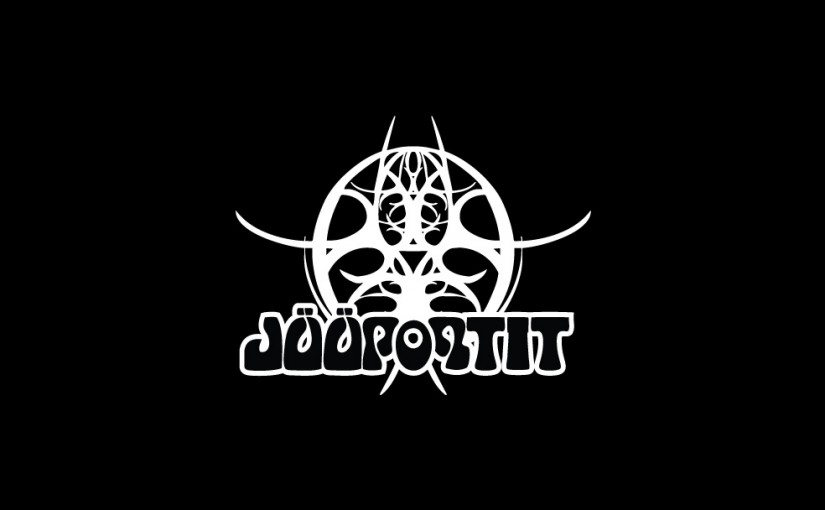
A: Well, this Jääportit symbol, that I once created, is supposed to represent the same things as the band name: it’s a portal between this world and the frosty depths of unknown dreamspheres. There’s an alien look-alike person with a triangle between the eyes and above him are branches of trees and a gateway. All this is covered in a circle with thorns that protect it against unpleasant surprises and uninvited visitors. All in all there’s a lot going on in the symbol and everyone can freely discover meanings of their own for it.
The primary Jääportit logo today is the logotype designed by Aslak Tolonen.
Q: One thing caught my attention: why everything blue? What does this colour mean to you?
A: I like deep dark blue and ultramarine blue colors. I guess it’s the color to express who I am and how I think, see and experience this world around me. I’ve read that it’s a color that expresses melancholy, tranquillity, coldness, night, ocean and sky. Those things matter to me, and I think they can be heard in my music too.